
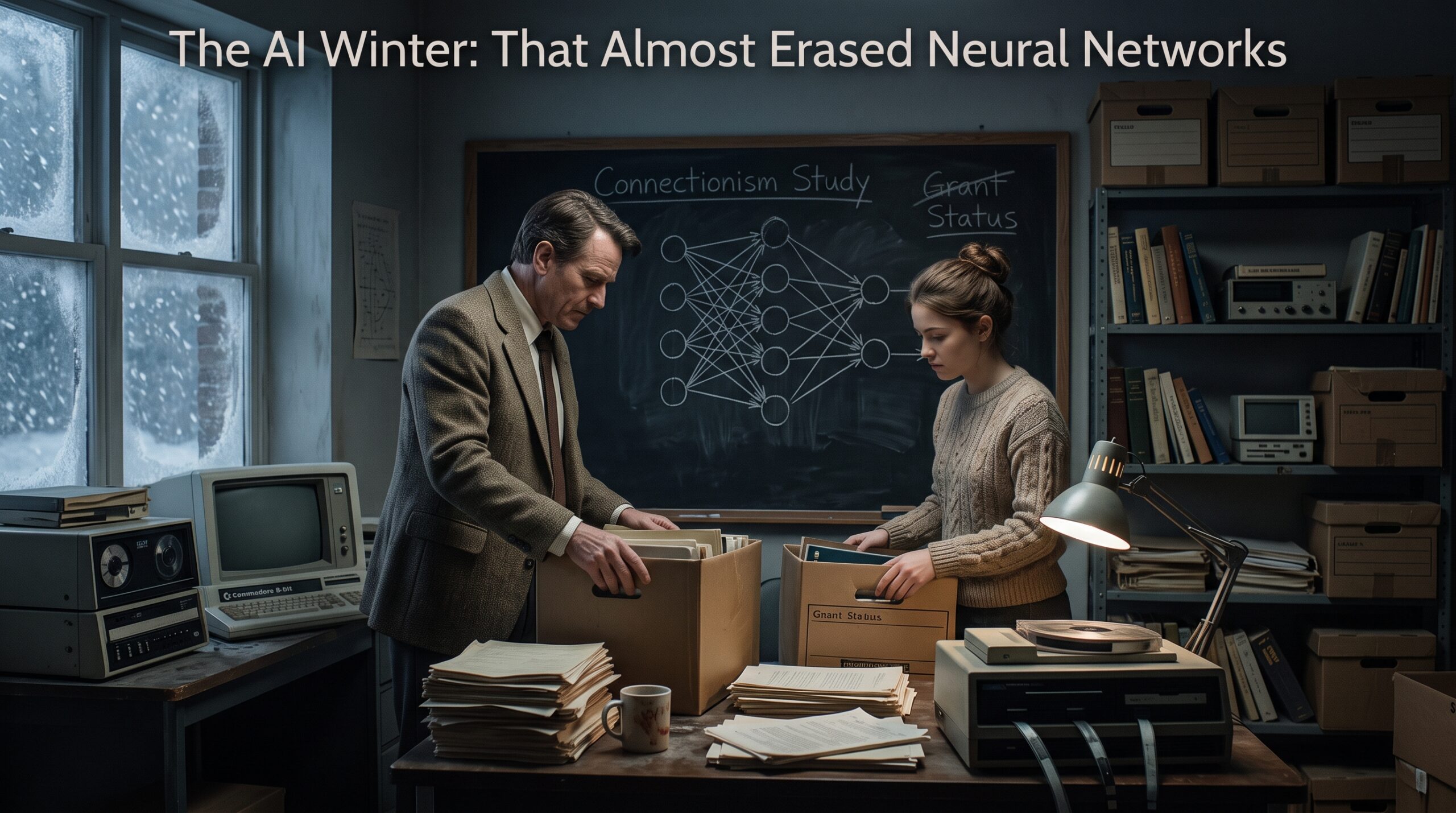
The Day the Computers Froze: The 1969 Debate That Paralyzed Machine Learning
In the late summer of 1958, a young psychologist named Frank Rosenblatt walked into the United States Office of Naval Research carrying an audacious promise. He unveiled the “Perceptron,” an electromechanical contraption the size of a minivan, wired together with potentiometers, rotary motors, and primitive optical sensors.
Rosenblatt made a bold claim that captured the front page of The New York Times: humanity was on the verge of creating a machine that could walk, talk, see, write, reproduce itself, and become conscious of its own existence.
For a moment, the world believed him. Silicon dreams seemed just an arm’s length away. Yet just a decade later, the entire field of neural networks lay in ruins. Funding vanished overnight, labs shuttered, and a silence settled over artificial intelligence that lasted nearly two decades. This was the first true AI Winter, and it wasn’t triggered by technical exhaustion alone—it was ignited by intellectual warfare.
The Spark: What Rosenblatt Actually Built
To appreciate the freeze, one must understand what Rosenblatt’s Perceptron really was. Inspired by Warren McCulloch and Walter Pitts’ 1943 mathematical abstractions of biological neurons, Rosenblatt built a physical machine that took sensory inputs, assigned numeric weights to them, summed them up, and triggered an output if the total passed a threshold.
It was an analog binary classifier. It could learn by adjusting its internal potentiometer dials when it made an error. If shown cards with letter shapes, it could gradually identify an “A” from a “B.”
To early cyberneticists, this was alchemy. Up to this point, computing was rigidly deductive: a human programmer wrote an explicit recipe, and the computer followed it blindly. The Perceptron offered an alternative paradigm: connectionism. Don’t program the computer; teach it. Let it learn patterns inductively from data.
The Counter-Attack: Logic vs. Intuition
While Rosenblatt toured universities championing biologically inspired machines, a rival school of thought grew at the Massachusetts Institute of Technology. Led by Marvin Minsky and Seymour Papert, this camp championed symbolic AI (often nicknamed GOFAI: “Good Old-Fashioned AI”).
Symbolic AI argued that human intelligence is built on the manipulation of symbols through logical rules—formal languages, semantic trees, and if-then predicates. To Minsky and Papert, the connectionist approach was crude, mathematically unprincipled, and excessively hyped.
In 1969, Minsky and Papert published a devastating book titled simply Perceptrons.
The book provided a rigorous mathematical autopsy of single-layer perceptrons. Its central proof was deceptively simple: a single-layer perceptron could not compute the basic exclusive-or function—the XOR problem.
Input A | Input B | XOR Output
0 | 0 | 0
1 | 0 | 1
0 | 1 | 1
1 | 1 | 0
A single-layer perceptron operates by drawing a single straight line through a coordinate space to divide classes (linear separability). The XOR truth table cannot be separated by a single straight line.
While Minsky and Papert conceded in technical footnotes that multi-layered networks could solve this problem, they openly conjectured that extending them would be computationally sterile and mathematically intractable.
The Frost Sets In
The fallout was immediate and catastrophic. The book did not merely initiate academic discourse; it acted as an intellectual guillotine.
Government agencies like the Defense Advanced Research Projects Agency (DARPA) and the UK’s Science Research Council (prompted by the infamous 1973 Lighthill Report) slashed research grants. Researchers who dared mention “neural networks” on grant applications found their proposals rejected without review. To survive academically, an entire generation of computer scientists scrubbed connectionist terminology from their papers, rebranding their work as “adaptive pattern recognition” or “cybernetic mathematics.”
Tragically, Rosenblatt died in a boating accident in July 1971 on his 43rd birthday, never seeing his life’s intuition vindicated. For fifteen years, symbolic logic reigned supreme, churning out brittle expert systems that crumbled whenever they encountered ambiguity.
The Underground Resistance
Science advances through patient outcasts. During the darkest years of the AI Winter, a handful of defiant researchers kept the connectionist flame flickering in quiet obscurity:
- Geoffrey Hinton, a British cognitive psychologist who refused to abandon the belief that the brain’s messy network architecture held the secret to thought.
- David Rumelhart and James McClelland, cognitive scientists at UC San Diego who formed the PDP (Parallel Distributed Processing) group.
- Paul Werbos and Yann LeCun, mathematicians and engineers exploring efficient error propagation.
In 1986, Rumelhart, Hinton, and Ronald Williams published a landmark paper in Nature: “Learning representations by back-propagating errors.”
They proved that by cascading neurons into multiple hidden layers and using calculus (the chain rule) to propagate the error backward through the network, the machine could adjust internal weights seamlessly. The XOR problem wasn’t a death sentence; it was simply a hurdle waiting for multi-layer depth.
Why the AI Winter Matters Today
Modern artificial intelligence did not arrive through an unbroken march of triumphs. It was forged in a brutal clash of paradigms. The large language models, computer vision systems, and autonomous engines powering the modern digital economy are the direct lineal descendants of Rosenblatt’s potentiometer-laden box.
The primary lesson of the first AI winter is intellectual humility. When symbolic AI asserted that statistical connectionism was a dead end, it set computer science back by two decades. As we navigate contemporary debates surrounding machine intelligence, reasoning, and artificial general intelligence (AGI), remembering the frost of 1969 reminds us that the prevailing dogma of today is often the blind spot of tomorrow.