The Audacious Million-Dollar Bet
On October 2, 2006, Netflix was an upstart DVD-by-mail service locked in a grueling war of attrition against brick-and-mortar giant Blockbuster. Netflix’s competitive advantage rested on its ability to steer subscribers away from smash-hit Hollywood blockbusters (which had scarce DVD inventory and licensing fees) and toward the vast, quirky back-catalog of indie cinema and obscure documentaries.
The engine driving this strategy was Cinematch, a recommendation algorithm built on simple nearest-neighbor heuristics. It worked decently, but Netflix wanted more.
Reed Hastings made a move that altered data science history: he released a dataset of 100,480,507 ratings from 480,189 anonymous users across 17,770 movies. The challenge was simple: the first team to beat Cinematch’s root mean square error (RMSE) benchmark by 10% would win $1,000,000.
Over 40,000 teams from 186 countries entered the arena. Physicists, mathematicians, and garage hackers competed across a live leaderboard for nearly three years. It remains the most celebrated data science competition of the century.
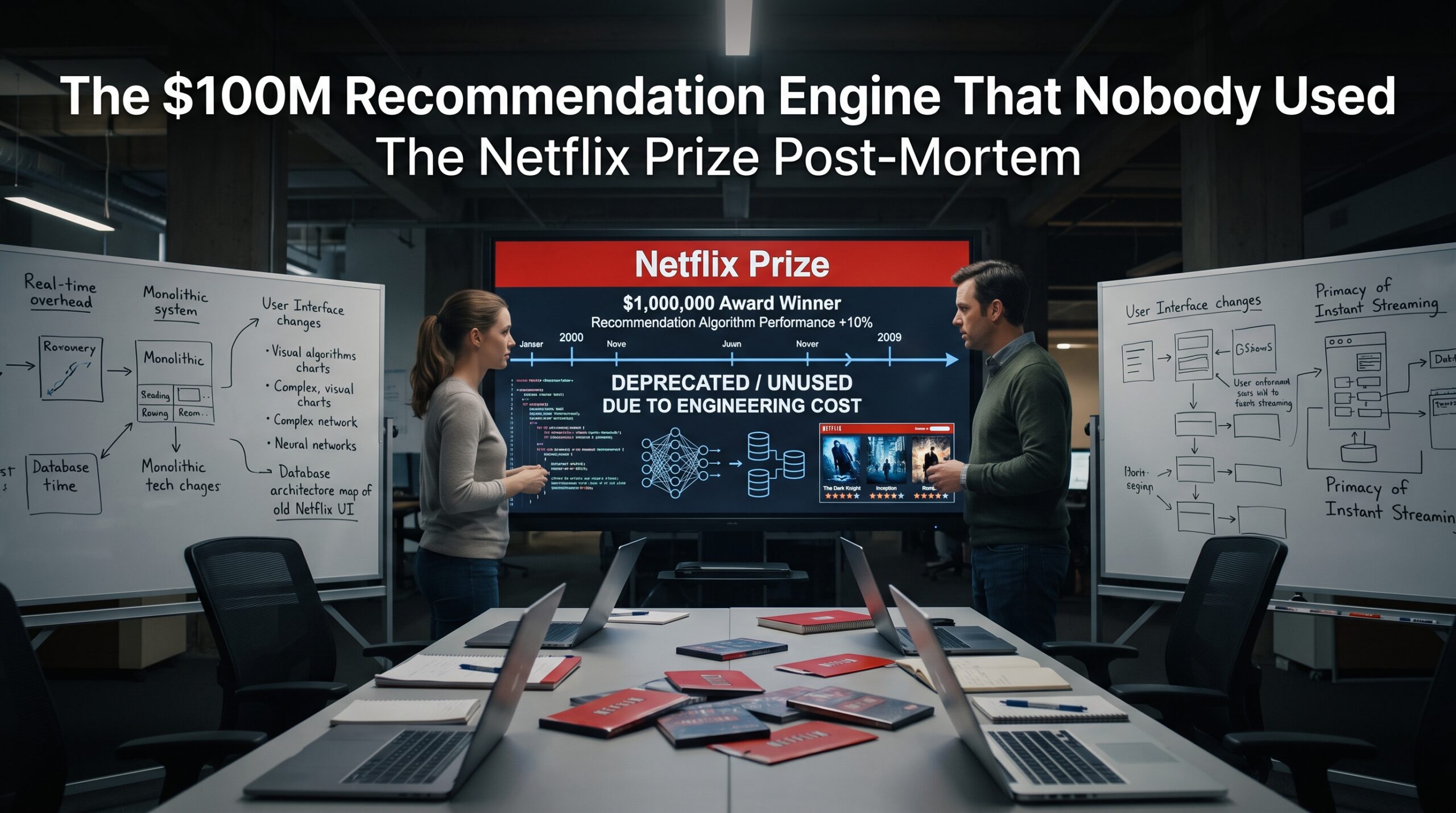
Yet when the confetti cleared, the champion algorithm was never put into production.
The Breakthrough: When Math Discovered Film Genres
Early machine learning models relied heavily on explicit metadata: did the movie star Tom Hanks? Was it directed by Steven Spielberg? Was it categorized as “Romantic Comedy”?
The teams competing for the prize took an entirely different route: latent factor models and Matrix Factorization (Singular Value Decomposition – SVD), spearheaded by Yehuda Koren and the team BellKor.
Imagine a giant, sparse spreadsheet with 480,000 rows (users) and 18,000 columns (movies). Most cells are blank because no user has seen more than a fraction of the library. Matrix factorization mathematically compresses this colossal, empty grid into two much smaller, dense matrices:
Rating(u,m)k=1KPu,kQm,k
Where:
- P captures user preferences across K hidden mathematical concepts.
- Q captures movie characteristics across those same K concepts.
The magic of SVD was that nobody had to label the axes. The math uncovered human emotions naturally. One axis might unintentionally map “dark, gritty drama vs. lighthearted family entertainment.” Another mapped “slow, intellectual pacing vs. fast explosions.”
By collapsing user vectors against movie vectors, the models discovered uncanny psychological tastes no human tagger could have anticipated.
The Frankenstein Ensemble
By 2009, the competition had reached a stalemate. Individual models had plateaued around an 8% to 9% improvement. To cross the mythical 10% threshold, competitors formed alliances.
The final winning coalition—BellKor’s Pragmatic Chaos—secured victory on July 26, 2009, edging out second-place team “The Ensemble” by a margin of 20 minutes before the buzzer. Their score: 10.06% improvement.
To cross that finish line, the coalition had constructed a towering monument to algorithmic complexity. The winning submission was not a single, elegant algorithm; it was an ensemble of over 100 distinct machine learning models, blended together through multiple layers of meta-regressors.
It contained:
- Matrix factorization models with temporal dynamics (accounting for ratings drifting over time).
- Restricted Boltzmann Machines (neural architectures for collaborative filtering).
- K-nearest neighbor clustering across residual errors.
- Complex gradient-boosted decision trees tying the components together.
It was an academic and mathematical masterpiece. And it was dead on arrival for production.
Why the Winner Was Shelved
In 2012, Netflix’s engineering team published a brutally honest blog post that sent shockwaves through the machine learning community. They admitted that while they adopted an early, simplified version of BellKor’s matrix factorization (which yielded an 8% boost), they had abandoned the prize-winning code entirely.
Why? Three fundamental realities of production systems had collided with competitive machine learning:
1. The Cost of Latency and Scale
Calculating the predictions of 100+ ensembled models in real time required computational resources that outweighed the business value. If an algorithm takes 500 milliseconds to calculate a recommendation, the customer experiences UI stutter. In e-commerce and streaming, an extra 200ms of latency translates to direct user drop-off.
2. The Business Shift: From DVDs to Streaming
Between the competition’s launch in 2006 and its end in 2009, Netflix transformed from a DVD shipping service into an instant streaming service.
In the DVD era, a user spent five minutes queuing up movies that would arrive in their mailbox three days later. High accuracy on single ratings mattered immensely.
In the streaming era, user interaction shifted completely:
- Users didn’t want to rate movies on a 1-to-5-star scale; they wanted to click play.
- A user’s current session context (time of day, device, viewing streak) became far more predictive than a movie they watched two years ago.
- The critical metric was no longer Predictive Error (RMSE); it was Time to First Stream and Churn Prevention.
3. Maintenance and Technical Debt
Maintaining a production pipeline with over 100 interdependent algorithms is an operational nightmare. A bug in model #47 can contaminate the inputs of model #82. When customer taste shifts, retraining 100 models concurrently creates prohibitive operational fragility.
The Real Legacy of the Netflix Prize
The $1,000,000 check was not wasted money. For Netflix, it was the greatest PR and recruitment campaign in tech history, establishing them as an elite destination for machine learning talent.
For the field of AI engineering, it served as a masterclass in the difference between Kaggle-style performance and production software engineering.
A model in a notebook exists in a vacuum where only metric accuracy matters. A model in production lives inside an economic ecosystem bounded by latency budgets, hardware costs, shifting product roadmaps, and maintenance overhead.
The most accurate algorithm is worthless if it cannot run before the user closes the browser.