The Silent Killer in Room 412
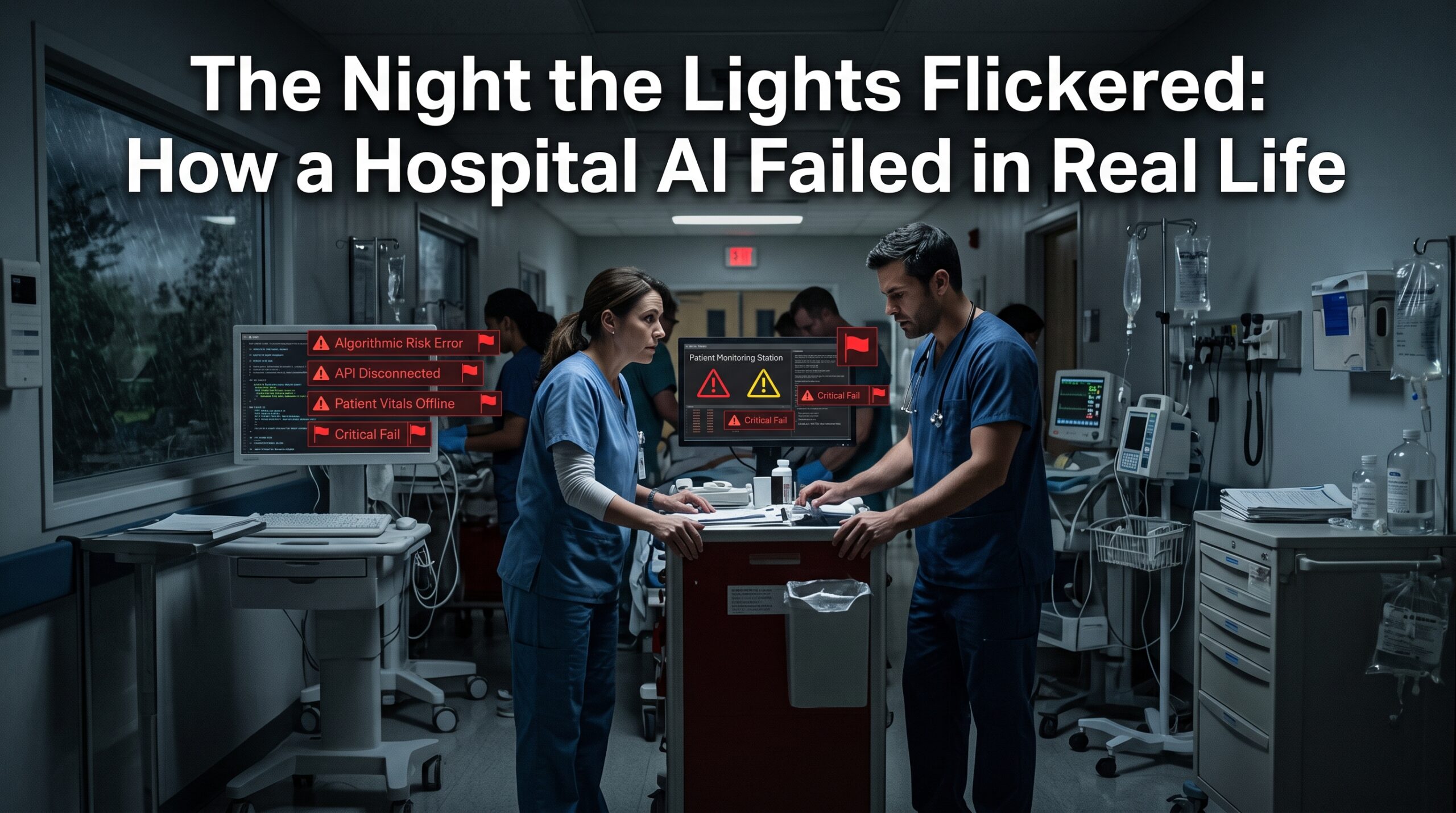
At 2:15 AM in an urban intensive care ward, an alarm beeped on the nurse’s station terminal. A small red banner flickered next to the record for a 64-year-old post-operative patient in Room 412:
SEPSIS RISK ELEVATED: RISK SCORE 68
The night nurse, running through her twelfth hour of an understaffed shift, glanced at the monitor, clicked “Acknowledge,” and returned to administering IV antibiotics to a critically ill pneumonia patient across the hall.
It was the fourteenth sepsis alert her station had received that evening. The prior thirteen had all been false alarms—triggered by an elevated heart rate due to post-surgical pain, a momentary spike in body temperature, or simple movement that jostled a sensor.
Four hours later, the patient in Room 412 experienced a catastrophic blood pressure drop. His skin turned mottled; his kidneys ceased functioning. He was in septic shock.
The algorithm had accurately flagged him—yet the system had failed completely. Why? Because the hospital was running on an AI model that was technically present, mathematically scored, and utterly decoupled from clinical reality.
Sepsis: The Holy Grail of Predictive Healthcare
Sepsis is the body’s extreme, life-threatening response to an infection. It is a medical emergency where hours mean the difference between life and death. For every hour that effective antibiotic treatment is delayed, mortality increases by an estimated 4% to 7%.
The challenge is detection. Early sepsis looks like a dozen harmless conditions: a mild fever, a slightly elevated respiratory rate, a general sense of fatigue. By the time a patient displays overt signs of septic shock, tissue damage has already begun.
To hospital administrators, predictive machine learning seemed like the ultimate savior. If an algorithm watching the stream of electronic health records (EHR) could detect the subtle constellation of vital signs, lab values, and medication records that precede sepsis, clinicians could intervene hours early.
Enter the Epic Sepsis Model (ESM). Developed by Epic Systems—the healthcare software giant whose systems store the medical records of more than half of the United States population—the proprietary model was rolled out across hundreds of health networks nationwide.
The Illusion of Accuracy
The marketing promise was seductively straightforward. ESM calculated a continuous sepsis risk score using dozens of clinical variables pulled directly from the patient’s chart in real time.
The vendor’s internal documentation suggested outstanding discriminatory power, boasting an Area Under the Receiver Operating Characteristic curve (AUROC) between 0.76 and 0.83. In academic data science, an AUROC above 0.8 is considered strong. Hospital executives felt confident purchasing and deploying the software.
Then, a research team from the University of Michigan Medical School led by Dr. Karandeep Singh decided to do what had never been done: conduct an independent, rigorous, external validation of the model in the wild.
In 2021, they published their findings in JAMA Internal Medicine. The results shook the clinical informatics world to its foundation.
The Autopsy: What Went Wrong
When evaluated on 27,697 patient admissions across a major academic healthcare system, the algorithm’s real-world performance collapsed:
Metric | Vendor Claim | Real-World (JAMA Study)
—————————-|—————|————————-
AUROC (Discriminative Power)| 0.76 – 0.83 | 0.63
Sensitivity | High | 33%
False Positives | Low | 88% of all alerts
The model was missing two out of every three patients who actually developed sepsis. Even worse, of the thousands of alerts it fired across hospital floors, 88% were false alarms.
How could a model score brilliantly in vendor benchmarks and fail so spectacularly at the bedside? The post-mortem revealed systemic flaws that plague AI deployments across all industries.
1. Label Contamination and Retrospective Bias
The model had been trained on retrospective EHR data using a flawed definition of sepsis onset. In retrospective data, an algorithm can take advantage of subtle human artifacts:
- A doctor orders a blood culture because they suspect sepsis.
- The model spots the blood culture order and raises the sepsis score.
- The model looks accurate, but it isn’t predicting sepsis—it is merely parroting the physician’s existing suspicion.
When deployed prospective-live, the model didn’t receive that human order early enough to help. It was locked in an echo chamber of historical clerical habits.
2. Alert Fatigue: The Human Firewall Breaks
A model with an 88% false alarm rate does not merely waste time; it actively endangers lives.
When human beings are bombarded with hundreds of automated notifications per day that yield no actionable insight, their brains adapt. Nurses and physicians suffered from severe alert fatigue. The sound of the alarm ceased to trigger vigilance; it triggered automatic dismissal.
When the system correctly flagged the deteriorating patient in Room 412, the alert vanished into a sea of digital noise.
3. Data Drift and Local Variation
Healthcare is not uniform. The frequency of vital sign measurements, nursing protocols, and lab equipment calibration in an urban trauma hospital in Michigan is entirely different from a suburban community hospital in Florida.
Because the model was proprietary (“black box”), local hospital teams could not inspect the feature weights, adapt it to their own patient demographic, or recalibrate thresholds for their specific staffing ratios.
The Road Ahead: Algorithmic Humility in High-Stakes AI
The failure of the Epic Sepsis Model is not a story about malevolence or technological uselessness; it is an indictment of the plug-and-play AI fantasy.
Deploying AI in mission-critical environments cannot be treated like updating smartphone software. Predictive tools require:
- Prospective clinical trials rather than retrospective observational studies.
- Radical transparency, allowing local practitioners to audit underlying weights and features.
- Human-centric user experience design, ensuring algorithms fit seamlessly into physical workflows rather than creating psychological fatigue.
Artificial intelligence does not practice medicine; doctors and nurses do. An algorithm that scores an A on a static dataset is an utter failure if it earns an F in human collaboration.
Article 4: The 1980s Game Designer Who Accidentally Taught AI to Read
- SEO Slug: /history-terry-sejnowski-nettalk
- Target Primary Keyword: NETtalk neural network history
- Secondary & Semantic Keywords: Terry Sejnowski, speech synthesis AI history, connectionism artificial intelligence, parallel distributed processing, DECtalk vs NETtalk, early deep learning
- Meta Title: The 1980s Breakthrough That Accidentally Taught AI to Read | TensorTales
- Meta Description: In 1986, Terry Sejnowski plugged a neural network into a speaker. What emerged began as baby babble—and ended with a computer that taught itself to read aloud.
- Suggested Hero Image: An authentic, retro 1986 computer lab with a beige DEC workstation, an oscilloscope, a monochrome monitor displaying glowing green neural activations, and an external desktop speaker emitting sound waves.
The Babbling Machine
In late 1985, visitors walking past the basement laboratories of Johns Hopkins University were often stopped dead in their tracks by a chilling sound echoing into the hallway.
It sounded like a human infant learning to speak.
First came chaotic, guttural noises—clicks, rasps, and sustained vowels that had no rhythm or cadence. A few hours later, the voice shifted into repetitive rhythmic babbling: “da-da-da, ba-ba-ba.” By morning, the cadence tightened, phonemes stitched together into broken syntax, and by the next afternoon, a robotic voice was reading an English transcript with an unmistakable voice:
“…yesterday… we… went… to… the… park…”
The sound was not coming from a child. It was coming from NETtalk, an artificial neural network consisting of just a few hundred simulated brain cells running on a beige desktop computer. It was the brainchild of biophysicist Terry Sejnowski and cognitive scientist Charles Rosenberg.
At a time when mainstream computer science insisted that language required exhaustive, hand-coded logic books, NETtalk accomplished something unthinkable: it taught itself to read plain English text without a single rule of grammar programmed into its memory.
The Linguistic Trap: Why English Breaks Machines
To understand why NETtalk was revolutionary, one must remember how brutal the English language is to a computer.
English is not a phonetic system; it is an archaeological dig site. Centuries of Anglo-Saxon roots, Norse invasions, French nobility imports, and Latin borrowings have left the language riddled with contradictions.
Consider the sequence of letters “ough”:
- Though (pronounced “oh”)
- Through (pronounced “oo”)
- Rough (pronounced “uff”)
- Cough (pronounced “off”)
- Bough (pronounced “ow”)
In the early 1980s, the state of the art in speech synthesis was Dennis Klatt’s DECtalk (the iconic voice later used by Professor Stephen Hawking). DECtalk was a triumph of engineering, but it was built on an army of brittle linguistic rules. It contained hundreds of hard-coded phonetic transformations and massive internal dictionaries listing thousands of irregular exceptions.
If a word followed the rules, DECtalk spoke it cleanly. But if it encountered a typo, an unfamiliar slang term, or an uncataloged foreign name, the system stumbled or crashed.
Sejnowski and Rosenberg asked a fundamentally radical question: what if we gave the computer zero pronunciation rules? What if we gave it a tiny, blank neural network and simply punished it when it pronounced a word wrong?
Inside the Architecture of NETtalk
NETtalk was built around a modest architecture that seems impossibly small compared to today’s billion-parameter language models:
- Input Layer: 7 groups of neurons. Each group represented one letter of a moving text window (7 letters wide). The network read text by sliding this window across words, trying to determine the correct phonetic sound for the letter in the center.
- Hidden Layer: A single intermediate layer of 80 neurons.
- Output Layer: 26 neurons, each corresponding to a phonetic articulatory feature (e.g., voiced, unvoiced, nasal, labial) that could drive an external speech synthesizer chip.
[Text Input Window: ” _ c a t _ _ ” ]
│
▼
[ 7 Input Letter Groups ]
│
▼
[ 80 Hidden Processing Neurons ] <— (Learned Phonetic Patterns)
│
▼
[ 26 Articulatory Feature Neurons ]
│
▼
[ DECtalk Hardware Synthesizer ] ===> Audio Sound Waves: /k/ /æ/ /t/
The entire system contained approximately 18,000 synaptic weights—a speck of dust compared to the hundreds of billions of weights in modern transformer networks.
The Overnight Metamorphosis
The learning process used David Rumelhart’s newly popularized backpropagation algorithm.
Sejnowski and Rosenberg fed the network a training text: a continuous phonetic transcription of an elementary school child’s speech. The network would read a letter, make an initial, random guess at its sound, and output audio through a synthesizer.
The computer then checked the network’s guess against the true phonetic transcription. If the network guessed incorrectly, an error signal was calculated and backpropagated through the 80 hidden neurons, adjusting the mathematical strengths of their connections.
What made NETtalk spellbinding was that Sejnowski wired the synthetic output directly to a speaker in real-time as the training progressed. Researchers gathered around to listen to an algorithm undergo cognitive development:
- Step 1 (Zero Training): Complete acoustic chaos. White noise, clicks, random hissing. The synaptic connections were random numbers.
- Step 2 (5 Passes): The network discovered vowels. Vowels are continuous and carry high acoustic energy. The network began to produce long, rhythmic chants, sounding like an infant cooing in a crib.
- Step 3 (10 Passes): Consonants emerged. The network learned to distinguish hard stops (like p and t) from vowels. The output sounded like toddler babble: “ba-ga-da-ma.”
- Step 4 (50 Passes): Word boundaries formed. The network learned that spaces between words required a brief acoustic pause.
- Step 5 (Final Iteration): The machine spoke coherent, recognizable English sentences with a distinct, slightly nasal accent.
When the researchers gave NETtalk an entirely new text it had never encountered before—a passage of adult prose—it achieved 78% phonetic accuracy, smoothly extrapolating rules it had never been explicitly taught.
The Mystery in the Hidden Layer
NETtalk wasn’t just a technical achievement; it delivered an ontological shock to linguistics.
Linguists like Noam Chomsky had long asserted that language acquisition requires innate, symbolic mental structures. Yet here was a tiny, generic network of numerical weights that extracted the implicit structure of language entirely from statistical exposure.
When Sejnowski analyzed the 80 hidden neurons using cluster analysis, he uncovered something extraordinary:
The neurons had spontaneously organized themselves into meaningful linguistic categories without human intervention. One cluster of neurons activated exclusively for vowels; another activated for plosive consonants. Within the vowel cluster, the network had organized sub-nodes corresponding to tongue position (front vs. back vowels).
The machine had invented phonetic theory inside its own hidden weights simply because doing so was the mathematically optimal way to reduce error.
The Bridge to Tomorrow
NETtalk captured the imagination of the world. It was featured on national television, demonstrating to millions that computers could learn fluidly through connectionist architecture rather than rigid programming.
When you speak to a modern voice assistant, generate conversational text using an LLM, or dictate a message into your phone, you are experiencing the direct conceptual evolution of that noisy, babbling room at Johns Hopkins.
Terry Sejnowski proved that intelligence did not require humanity to handcraft every rule of the universe into code. Sometimes, all you need to do is give a network the room to make mistakes, listen to the echo of its errors, and let the mathematics do the rest.